In today’s fast-moving digital economy, businesses must understand not only their operations but also the people and groups that influence their success. This is especially true for modern e-commerce platforms like ShopNaclo, where multiple stakeholders shape growth, innovation, and long-term sustainability.
Assessing stakeholder influence shopnaclo is a critical process that helps identify who matters most, how they impact decisions, and what strategies ensure alignment with business goals. In this comprehensive guide, you will learn how to evaluate stakeholder influence, apply proven frameworks, and build effective engagement strategies.
What Is Stakeholder Influence?
Stakeholder influence refers to the ability of individuals or groups to affect a company’s decisions, performance, and strategic direction. These stakeholders may be internal (employees, management) or external (customers, investors, regulators).
For an e-commerce platform like ShopNaclo, stakeholder influence plays a vital role because the platform depends on collaboration, trust, and performance across multiple ecosystems.
Why Assessing Stakeholder Influence Matters
Understanding stakeholder influence is not optional—it is essential for business success. Here’s why:
1. Better Decision-Making
When you know who holds power and interest, you can prioritize decisions more effectively.
2. Risk Management
Stakeholders with high power can create risks if ignored. Proper assessment helps avoid conflicts.
3. Strategic Growth
By aligning with key stakeholders, ShopNaclo can scale faster and more efficiently.
4. Improved Communication
Clear stakeholder mapping ensures targeted and meaningful communication.
Overview of ShopNaclo as an E-commerce Platform
ShopNaclo is designed to simplify store management and provide advanced analytics for retailers and brands. It integrates tools for marketing, inventory management, and global scaling.
Because of its technology-driven nature, the platform interacts with a diverse group of stakeholders, each with unique expectations and influence levels.
Key Stakeholders and Their Influence
To effectively understand assessing stakeholder influence shopnaclo, we must first identify the main stakeholder groups.
1. Customers (Retailers and Brands)
Customers are the most influential external stakeholders.
Why They Matter
- They generate revenue
- They drive feature development
- They shape platform evolution
Their Influence
Retailers demand tools like:
- Integrated marketing systems
- Inventory tracking
- Global shipping capabilities
If their needs are not met, they can easily switch to competitors. Therefore, they hold high power and high interest, making them key players.
2. Employees and Management
Internal stakeholders play a direct role in innovation and execution.
Why They Matter
- They build and maintain AI systems
- They improve analytics features
- They ensure smooth operations
Their Influence
Employees influence:
- Product quality
- Customer satisfaction
- Operational efficiency
Although their power may vary, their interest remains high. Keeping them informed and motivated is essential.
3. Investors and Shareholders
Investors provide the financial backbone of ShopNaclo.
Why They Matter
- They fund expansion
- They influence strategic decisions
- They expect long-term returns
Their Influence
Investors often shape:
- Growth strategies
- Budget allocation
- Market positioning
They hold high power and high interest, making them critical stakeholders.
4. Suppliers and Integration Partners
These include third-party services such as:
- Payment gateways
- Shipping providers
- Social media integrations
Why They Matter
- They impact user experience
- They affect transaction success
- They influence scalability
Their Influence
Reliable partners improve conversion rates, while poor performance can harm reputation. Their influence is moderate but essential.
5. Regulators
Regulatory bodies ensure compliance with laws and standards.
Why They Matter
- They enforce tax regulations
- They protect user data
- They ensure fair business practices
Their Influence
Non-compliance can lead to penalties or shutdowns. Therefore, regulators have high power but varying interest levels.
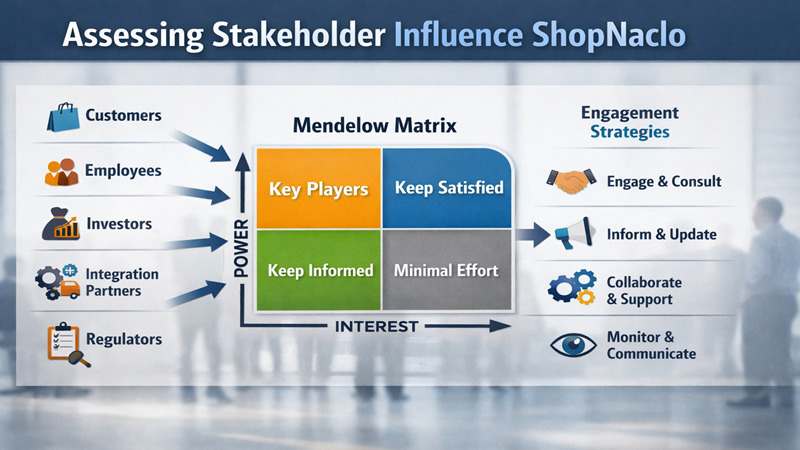
Stakeholder Assessment Framework: Mendelow Matrix
One of the most effective tools for assessing stakeholder influence is the Mendelow Framework. It categorizes stakeholders based on:
- Power (ability to influence decisions)
- Interest (level of concern or involvement)
Stakeholder Mapping Table
| Stakeholder Group | Power | Interest | Influence Level |
|---|---|---|---|
| Retailers (Customers) | High | High | Key Players |
| Investors | High | High | Key Players |
| Employees | Medium | High | Keep Informed |
| Integration Partners | Medium | Medium | Keep Satisfied |
| Local Communities | Low | Low | Minimal Effort |
How to Apply the Mendelow Framework
Step 1: Identify Stakeholders
List all individuals and groups connected to ShopNaclo.
Step 2: Analyze Power
Evaluate their ability to influence decisions.
Step 3: Measure Interest
Determine how much they care about outcomes.
Step 4: Map Them
Place stakeholders into the matrix.
Step 5: Develop Strategies
Create engagement plans for each category.
Stakeholder Engagement Strategies
Once stakeholders are mapped, the next step is engagement.
1. Key Players (High Power, High Interest)
Examples: Customers, Investors
Strategy
- Engage regularly
- Involve in decision-making
- Provide transparent updates
2. Keep Informed (Low Power, High Interest)
Example: Employees
Strategy
- Share updates
- Encourage feedback
- Maintain motivation
3. Keep Satisfied (High Power, Low Interest)
Example: Integration Partners
Strategy
- Maintain strong relationships
- Ensure smooth collaboration
- Address concerns quickly
4. Minimal Effort (Low Power, Low Interest)
Example: Local communities
Strategy
- Monitor occasionally
- Provide basic communication
Challenges in Assessing Stakeholder Influence
While the process is essential, it comes with challenges:
1. Changing Stakeholder Dynamics
Stakeholder power and interest can shift over time.
2. Conflicting Interests
Different stakeholders may have opposing goals.
3. Data Limitations
Incomplete data can lead to inaccurate assessments.
4. Communication Barriers
Poor communication can weaken relationships.
Best Practices for Effective Stakeholder Management
To overcome challenges, follow these best practices:
1. Continuous Monitoring
Regularly update stakeholder analysis.
2. Clear Communication
Use transparent and consistent messaging.
3. Data-Driven Decisions
Leverage analytics for better insights.
4. Relationship Building
Focus on trust and long-term engagement.
Role of Technology in Stakeholder Assessment
Modern platforms like ShopNaclo can use technology to improve stakeholder analysis:
- AI analytics for customer behavior
- CRM systems for relationship tracking
- Automation tools for communication
These tools make assessing stakeholder influence shopnaclo more accurate and efficient.
Future Trends in Stakeholder Influence
Looking ahead, several trends will shape stakeholder management:
1. Increased Customer Power
Customers will demand more personalization and control.
2. Data Privacy Regulations
Compliance will become even more critical.
3. Integration Ecosystems
Partnerships will grow in importance.
4. AI-Driven Insights
Automation will enhance decision-making.
Conclusion
Assessing stakeholder influence is a cornerstone of business success, especially for dynamic e-commerce platforms like ShopNaclo. By identifying key stakeholders, analyzing their power and interest, and applying frameworks like Mendelow’s Matrix, businesses can make smarter decisions and build stronger relationships.
In summary, assessing stakeholder influence shopnaclo enables better planning, improved communication, and sustainable growth. When businesses actively manage stakeholder relationships, they position themselves for long-term success in a competitive market.
For more info visit Shop Naclos